
Pest Library
Ticks
A genuine Hudson Valley concern, from lawn edges to leaf litter.
Overview
Ticks are one of the most consistent outdoor concerns for Hudson Valley homeowners. Blacklegged (deer) ticks, American dog ticks and lone star ticks all occur in the region, and the blacklegged tick is the species associated with Lyme disease transmission in New York.
Ticks do not jump or fly. They wait on vegetation — a behavior called questing — at the edges of lawns, trails and woodlines, and attach as people or animals brush past.
What to look for
Identify the pest
Compare what you found with these ticks reference materials.
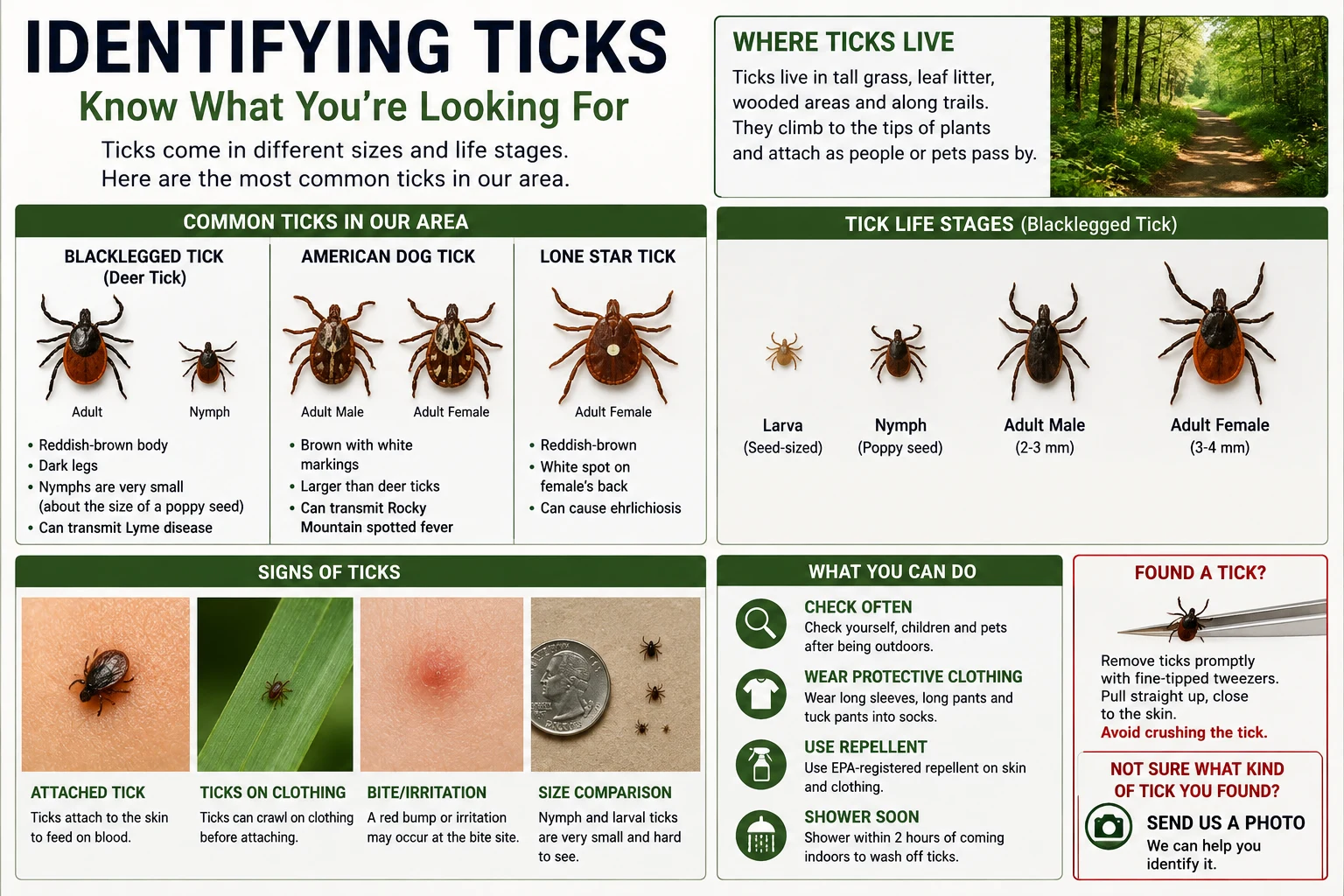
Identifying ticks: know what you're looking for
Common Hudson Valley tick species, life stages and size comparison, plus the signs people notice first.
Signs of activity
Most homeowners find the evidence before they find the pest. These are the things people usually notice first.
Attached tick
Attached ticks are often mistaken for a scab or freckle, especially at the nymph stage.
Ticks on clothing
Light-colored clothing makes ticks easier to spot after time outdoors.
Leaf litter
Ticks wait in damp leaf litter along wood lines rather than in open, sunny lawn.
Tall grass and yard edges
Transition zones between lawn, tall grass and woods are the highest-exposure areas.
Photos can help narrow down a pest problem, but many pests and signs of activity look similar. A photograph should not be treated as a definitive identification or diagnosis. Photo sources and credits.
Does this look familiar?
Pest signs aren't always easy to identify from pictures. Send us a photo of what you're seeing and tell us where you found it — we'll take ticks into account.
Why they're common in the Hudson Valley
- The Lower Hudson Valley is a well-documented high-incidence area for Lyme disease in New York State.
- Abundant deer and white-footed mice, along with fragmented woodland and residential development bordering forest, sustain tick populations.
- Shaded leaf litter, stone walls and ornamental ground cover hold the humidity ticks need to survive.
Signs of activity
- Finding ticks on people, pets or clothing after yard work
- Heavy deer traffic across the property
- Dense leaf litter, tall grass and brushy woodline edges
- Ground cover such as pachysandra or ivy along shaded foundations
Where you'll find them
- The transition zone where lawn meets woods
- Stone walls, wood piles and stacked landscape debris
- Shaded shrub beds and ornamental ground cover
- Trail edges, tall grass and unmaintained field borders
Why it matters
- Blacklegged ticks can transmit Lyme disease and other tickborne illnesses; the New York State Department of Health provides guidance on removal and symptoms.
- Most residential exposure happens within the yard, not deep in the woods, so property conditions matter.
- Pets can carry ticks indoors, extending exposure to the whole household.
Prevention
- Keep grass mowed and remove leaf litter, especially along the woodline
- Create a three-foot wood chip or gravel border between lawn and forest edge
- Move play equipment, patios and seating away from woodline edges
- Stack wood neatly and off the ground
- Use veterinarian-recommended tick prevention for pets
- Do a tick check after time outdoors and shower soon after yard work
When to get an inspection
- You are regularly finding ticks on family members or pets
- Your property borders woods, fields or trails
- You want a yard evaluation focused on habitat and treatment zones
- You are planning outdoor gatherings during peak season
Concerned about ticks around your property?
If the activity keeps coming back, an on-site inspection is the reliable next step.