
6 min read · Updated September 5, 2026
If you've ever noticed scratching in the walls shortly after the first cool nights of fall, you're not alone.
September and October are prime months for homeowners throughout Westchester, Putnam, Rockland, Dutchess and Orange Counties to begin noticing signs of mouse activity.
The reason is fairly simple.
Mice don't hibernate. They remain active throughout the winter, which means they need food and protected places to live when outdoor conditions become less favorable.
A heated Hudson Valley home can provide both.
Why mouse activity increases in the fall
Mice can live outdoors successfully throughout spring and summer. Fields, wooded areas, stone walls, gardens, sheds and dense vegetation provide plenty of food and hiding places.
Fall changes that environment.
Temperatures begin dropping
As overnight temperatures fall, protected structures become increasingly attractive.
A basement, crawlspace, garage or wall void offers mice a much more stable environment than an exposed outdoor nesting location.
Once inside, mice may remain active throughout the winter.
There are more mice competing for shelter
Rodent populations can increase during the warmer months when food and nesting opportunities are plentiful.
By late summer and early fall, there may simply be more mice competing for the best available shelter.
Homes located near woodlines, fields, stone walls, farms and undeveloped property can be especially susceptible as mice move between outdoor habitat and nearby structures.
Their outdoor environment is changing
Fall brings leaf drop, vegetation dieback, harvesting and changes in available seeds, insects and other food sources.
Cover that protected mice during summer also begins disappearing.
Your house, garage, shed or outbuilding suddenly becomes a very appealing alternative.
How small of an opening can a mouse use?
A house mouse can squeeze through an opening only about 1/4 inch wide — roughly the diameter of a pencil.
That means a home doesn't need an obvious hole in the foundation to have a mouse problem. A tiny construction gap can be enough.
Mice are also capable climbers, so don't assume entry points are limited to ground level. They can follow pipes, wires, siding and other structural features to reach openings higher on a building.
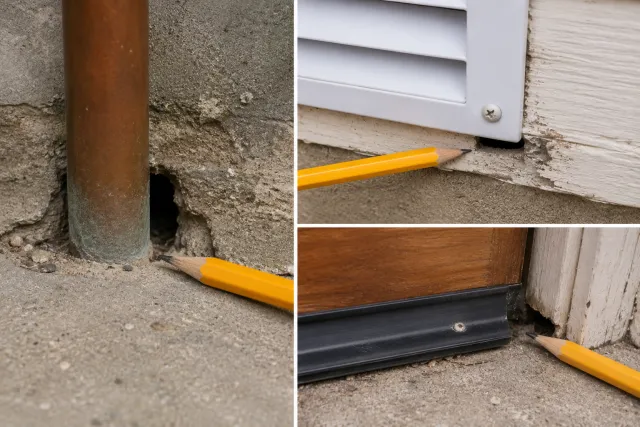
Small entry gaps
Gaps around pipes, vents and door sweeps the width of a pencil are enough for a mouse.
The most common mouse entry points
When inspecting a home for possible mouse access, pay particular attention to areas where different building materials meet or where utilities pass through the exterior.
- Gaps around plumbing, electrical, cable and HVAC penetrations
- Openings around basement windows
- Gaps beneath garage doors and exterior doors
- Damaged or missing door sweeps
- Dryer and exhaust vent openings
- Gaps where siding meets the foundation
- Openings around the sill plate
- Damaged soffits and fascia
- Unscreened or damaged vents
- Gaps around additions, decks and attached structures
One small opening can be all that's necessary. Our guide on how mice are getting into your house walks through the same openings in more detail.
Older Hudson Valley homes can present special challenges
The Hudson Valley has an enormous variety of housing, from newer subdivisions to homes built well over a century ago.
Older homes can present particularly interesting rodent-entry problems.
Fieldstone foundations, for example, are common throughout parts of the region. Over time, mortar can deteriorate and small gaps can develop between stones.
An opening that looks insignificant from outside may connect to a much larger cavity leading toward the basement, crawlspace or framing.
Older homes may also contain multiple generations of renovations. A pipe was moved. An old vent was abandoned. An addition was built. Siding was replaced. Utilities were upgraded.
Each modification creates another opportunity for a small opening to have been left behind.
Finding those openings is often more important than simply finding the mouse.
Signs mice may already be inside
The photos below come from our mice pest library page, where you can compare more examples of mouse activity.
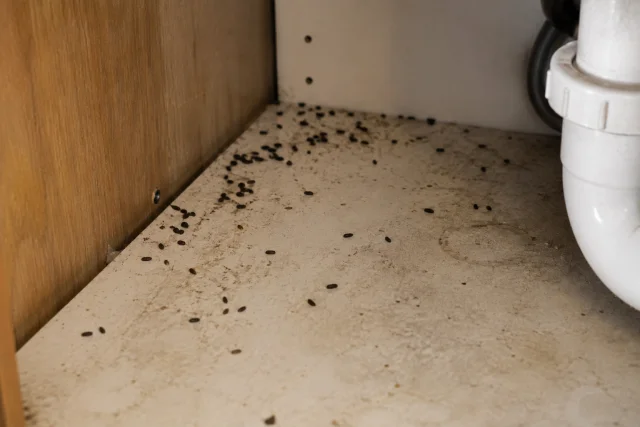
Droppings
Mouse droppings are small and rice-grain shaped, and often appear in lines along shelves, drawers or under sinks.
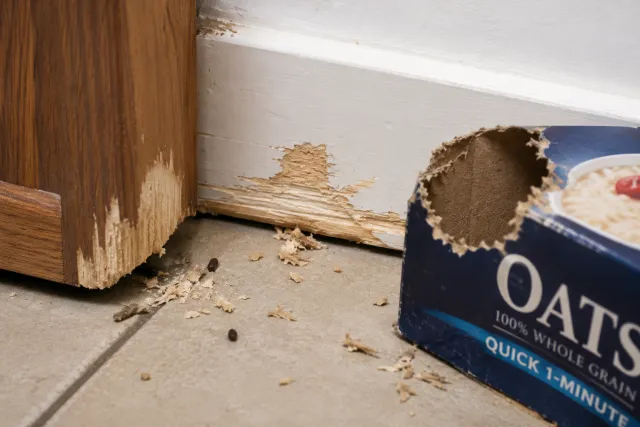
Gnaw marks
Fresh gnawing on trim, cabinets or packaging leaves light-colored, paired scrape marks.
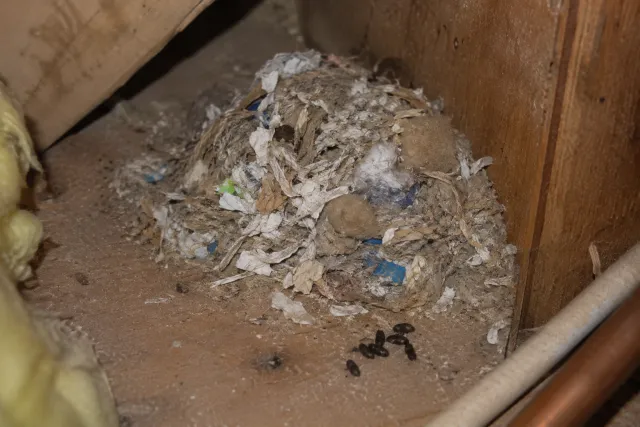
Nesting material
Shredded insulation, paper or fabric gathered in a hidden corner is a common nesting sign.
Droppings
Mouse droppings are small and generally rice-grain shaped. They are frequently found in drawers, cabinets, pantries, beneath sinks and along walls where mice travel.
Gnaw marks
Fresh gnawing on food packaging, wood, trim or other materials can indicate active rodents.
Freshly exposed material may appear lighter in color than older damage.
Scratching at night
Mice are often most active when the house is quiet.
Homeowners may hear light scratching, scurrying or movement inside walls, ceilings or attic spaces during the evening and overnight hours.
Nesting material
Mice may gather shredded paper, fabric, insulation and other soft materials to create protected nesting areas.
Food damage
Chewed bags, boxes and containers in a pantry or storage area can be another obvious warning sign.
Repeated sightings
Seeing a mouse once doesn't necessarily tell you how much activity exists.
However, repeated sightings — particularly during daylight hours — deserve attention.
Why sealing the house matters
Trapping mice can remove individual animals, but it doesn't necessarily address how they entered the house.
If an exterior opening remains available, additional mice may simply follow.
That's why long-term mouse management usually requires looking at both sides of the problem: what's already inside, and how they are getting in.
This process is commonly called exclusion — identifying and correcting the openings that allow pests or wildlife to enter a structure.
Don't automatically seal every hole if mice are already active
There's an important distinction between preventive exclusion and sealing a home after an infestation is established.
Late summer and early fall can be excellent times to inspect and correct potential entry points before mice move indoors.
But if mice are already living inside the structure, simply sealing every opening isn't necessarily the complete solution. The animals already inside still need to be addressed.
The goal should be to combine appropriate removal or control with exclusion so you're not continually dealing with new mice entering the structure.
What Hudson Valley homeowners can do before fall
A simple exterior inspection can uncover many potential problems.
Walk slowly around your house and look closely at the lower few feet of the structure, then inspect doors, vents and roofline areas.
Garage doors
Look at both lower corners with the door closed. Small gaps are common.
Utility penetrations
Inspect where pipes, wires and cables enter the house.
Foundation
Look for cracks, deteriorated mortar and gaps where different materials meet.
Doors
Check weatherstripping and door sweeps.
Vents
Make sure appropriate screens or covers are intact.
Siding and trim
Look for gaps, deterioration or openings created by previous repairs.
Vegetation
Dense vegetation against the house can provide rodents with cover as they investigate the structure.
The best time to prepare is before you hear scratching
Once mice are established inside walls, ceilings, basements or attics, figuring out where they're traveling can become more difficult.
That's why late summer and early fall are ideal times for a mouse-entry inspection.
Look for vulnerabilities while the weather is still comfortable and before colder nights begin pushing rodents toward structures.
A few seemingly insignificant gaps corrected now can potentially prevent a much more frustrating problem later in the season.